
We run a subscription service of our own. Its support desk spent most of its day on the same short list of questions: what is my balance, when does my subscription end, has my payment arrived, how do I set this up on a new device. In September we put a Telegram bot in front of that list, built it in a day, and then watched what actually happened.
The numbers below are from our own first week. They are small, because the audience we invited was small — that is the point of measuring early rather than later.
What we built
A bot in Telegram, connected to the business system we already run. A customer links their account once; after that the bot knows who is asking and answers from real records rather than from a script. Anything outside the list it is meant to handle goes to a person, with the detail already collected.
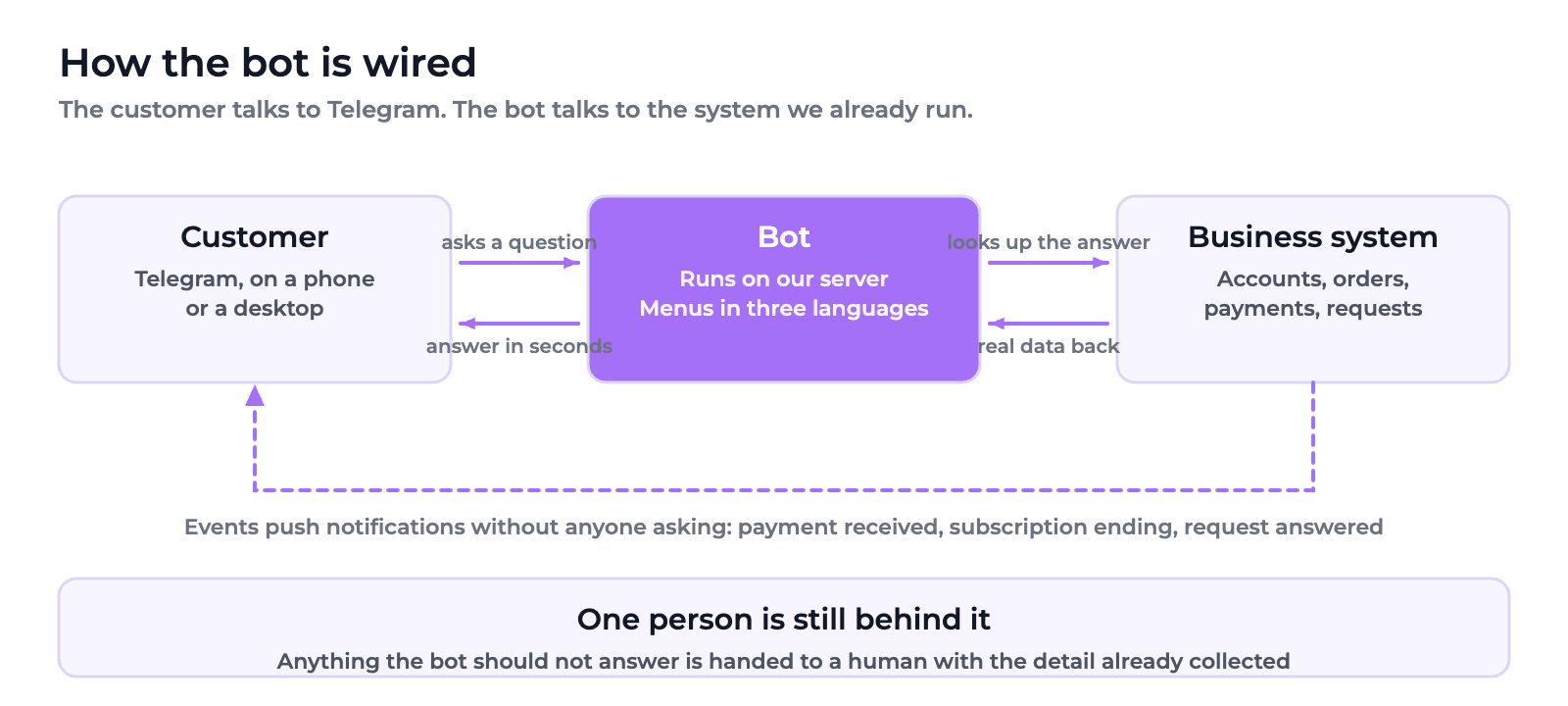
Three languages were built in from the start, because our customers write in all three. That turned out to cost almost nothing: the texts are a translation job, not development.
The first week, in numbers
49 people opened the bot. 37 of them linked their account — three quarters. 73 notifications went out over seven days without anyone pressing send. Five were active in the last twenty-four hours. One turned notifications off.
The number we care about is 37 of 49. An unlinked bot is a leaflet: it can show a menu and nothing else. A linked one answers about the person in front of it, and that is the whole difference. Three quarters linking on the first contact told us the flow was short enough.
What changed on the desk
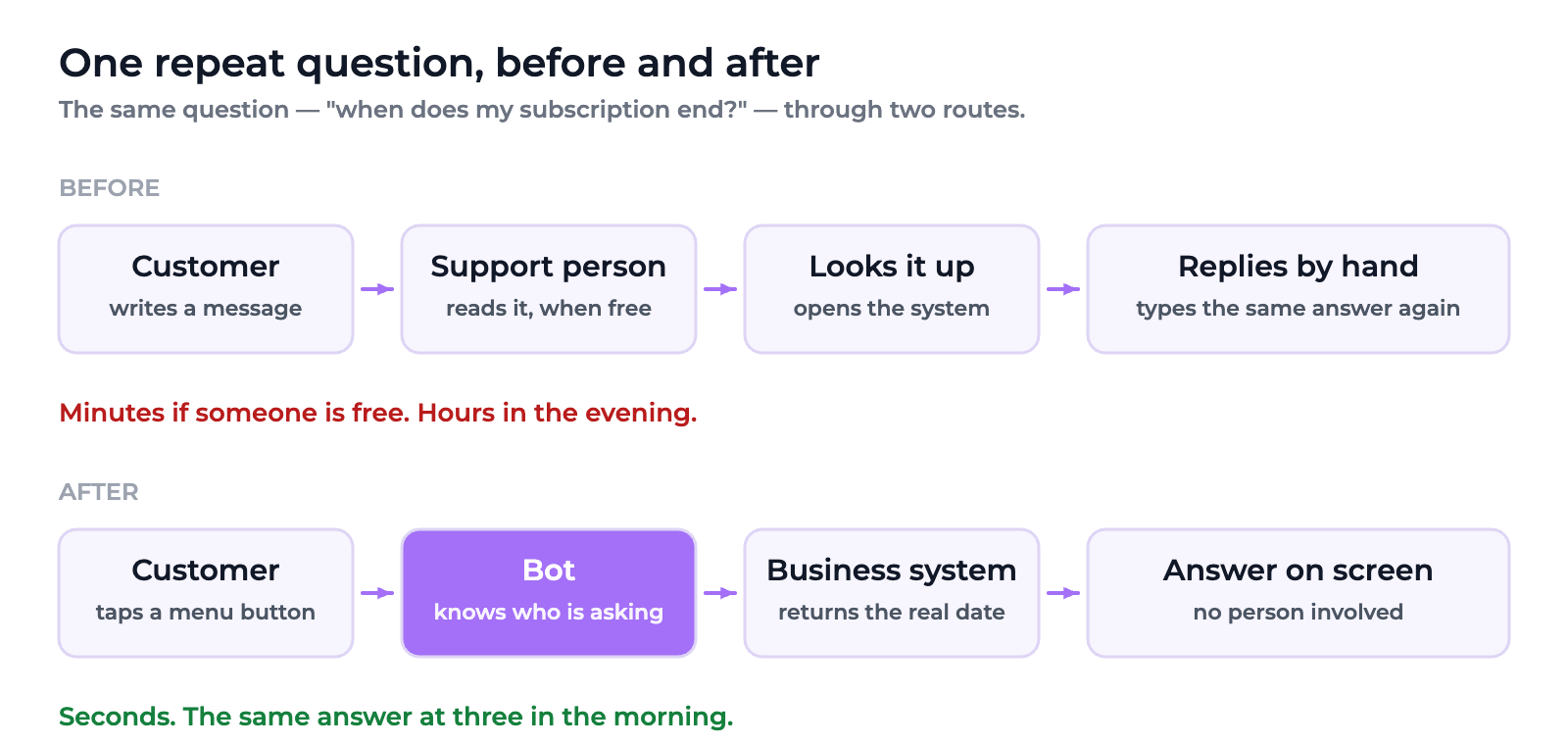
The repeat questions stopped arriving as messages. They did not disappear — they are still asked, just as often — but they are now answered without a person reading them first. Evenings and weekends changed the most: the same answer arrives at three in the morning as on a Tuesday.
The second change was quieter and we did not expect it. Fewer people opened a second request about the same thing, because they had already got an answer instead of waiting for one.
What did not work
Twelve of the forty-nine never linked their account. We do not know why, and guessing would be worse than saying so — it is on our list to ask them.
One customer turned notifications off within the week. That is a useful signal, not a defect: notifications have to be worth the interruption, and for that person they were not.
And the bot is no help at all with the difficult cases — the ones where somebody has to look, think and decide. It never was going to be. What it removed was the twentieth identical reply of the day, and that is a large share of a support desk without being the interesting part of it.
What it cost to build
One working day for the skeleton — menus, texts, deployment, tests — plus the integration with our own system, which we already knew inside out. That last part is what varies: if the system has a documented interface the work is predictable, and if it does not, the price depends entirely on what it allows.
We have since turned this into a service. The prices, the three integration situations and what monthly cover includes are on the Telegram bots for business page. If you want to know whether it is worth it for your own desk, the honest first step is to count how many of your questions repeat — we do that on a free call before quoting anything.
Would we do it again
Yes, and sooner. The mistake was not building it earlier: for a year the same answers were typed by hand while the data to answer them automatically was sitting in a system we already paid for.